

Defamation Lawyers in Melbourne
Defamation runs on two ticking clocks: 12 months to sue from publication, and 28 days to respond to a concerns notice. We act for both sides across Victoria, from social-media takedowns to Supreme Court trials.
- Free initial advice
- Senior lawyer on every file
- 24/7 availability
Free initial advice from senior lawyers
Defamed, or served with a concerns notice? You are on the clock from today.
Defamation runs on two ticking clocks: 12 months to sue from publication, and 28 days to respond to a concerns notice. We act for both sides across Victoria, from social-media takedowns to Supreme Court trials.
Areas we run
MK Law represents clients across Victoria on the following matters
Two clocks are running. Read this first.
If you have been defamed in Victoria, you have 12 months from publication to file. If you have just been served a concerns notice, you have 28 days to respond. Miss either deadline and good claims die for procedural reasons. The Defamation Act 2005 (Vic), as reformed in 2021, made the concerns notice a mandatory pre-court step and tightened the serious-harm test every plaintiff has to meet. Those changes were adopted almost everywhere, so defamation law in Australia now runs as one national scheme with Western Australia the notable holdout.
Whether you are the person attacked or the person accused, call MK Law on 1800 130 120 today. The first call is free.
The concerns notice decides most defamation matters before a court is ever involved. A precise one, with each imputation particularised and the harm spelt out, routinely produces a takedown, an apology or a payment inside 28 days. A vague one fails the mandatory pre-court step and stalls the whole claim. This is not the document to draft yourself.
What you actually have to prove
Since the 2021 reforms there are four elements, not three. Every plaintiff has to show all four, and our plain-English guide to what is defamation takes them one at a time with worked examples.
Publication. The material was communicated to at least one person other than you. A direct message to you alone is not enough; a group chat, an email cc or a public post is.
Identification. You were identified, by name or by features that let an ordinary reader work it out. “The dentist on Glenferrie Road with the red door” can be enough if your patients recognise it.
Defamatory imputation. The words carry a meaning that lowers your reputation in the eyes of an ordinary reasonable person. Calling someone a thief, a fraud or unsafe almost always qualifies. Where the target is a person rather than a business, most callers know this as defamation of character.
Serious harm. The publication caused, or is likely to cause, serious harm to your reputation. For individuals that means lost work, broken relationships or documented distress; for businesses, serious financial loss. The threshold knocks out trivial claims early.
Know where you stand after one call
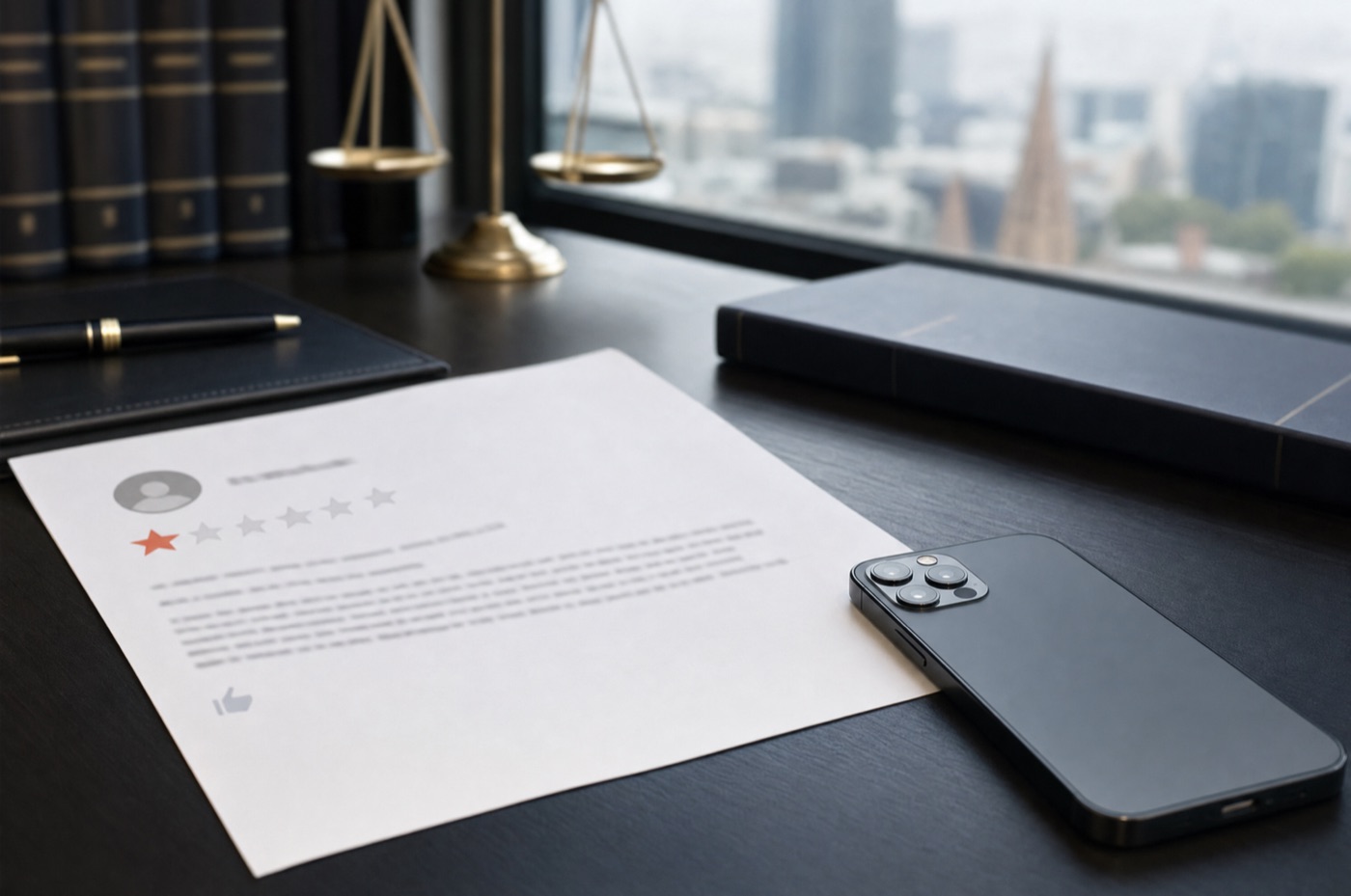
Most matters start with one screenshot: the review, the post, the email that went to the whole street. We read it on the first call and tell you whether it clears the serious-harm threshold, which imputations it carries, and how much time is left on the 12-month clock. If there is a claim, the next step is almost always a concerns notice, not a writ. By the end of the call you have a written view and a clear next step, or an honest reason we would not run it.
How defamation gets published
Defamation now lives mostly online. We act on Facebook posts, Instagram stories, TikTok captions, X threads, Google and Trustpilot reviews, LinkedIn updates, podcast episodes, YouTube videos, mass emails and WhatsApp group chats. Traditional print, radio and television defamation still happens and the test is the same. Australia scrapped the old slander vs libel divide in 2005, so words shouted across a car park are judged on the same test as a front-page headline. Posts and reviews move on their own tempo, and social media defamation covers what to capture in the first hour before anything gets deleted.
The concerns notice (this is where most matters end)
Since 1 July 2021 you cannot file a defamation claim in Victoria without first serving a concerns notice. The notice has to identify the publication, set out each imputation it carries, and explain the harm. The other side then has 28 days to respond, usually with an “offer to make amends” under the Act that, if accepted on reasonable terms, can end the matter. If the publisher needs more detail, they can request further particulars within 14 days of receiving the notice, which extends the clock until those particulars are supplied.
A well-drafted concerns notice signed by a lawyer routinely produces one of three outcomes inside the 28-day window: the post is taken down, an apology and retraction are published, or a payment is offered. Most files settle at this stage.
If you have been served with a concerns notice, do not respond on your own. A poorly drafted reply can lock you into admissions you cannot walk back, or waste the offer-to-make-amends defence that is often your best protection against damages.
Most defamation matters should never see a courtroom. The ones that settle fast settle at the concerns notice. The ones that drag on for years usually had no lawyer near the first letter.
MK Law Group
Identifying an anonymous publisher
A fake Google review, a burner X account, a pseudonymous comment under a news article. Before filing we apply for preliminary discovery under the relevant court rules, which compels the platform (Meta, Google, X, Reddit, the host) to release IP logs and account records for the suspected publisher. Where the publisher sits offshore we seek leave to serve overseas. If unmasking is not realistic we redirect to a platform takedown under community standards, which often resolves the harm faster than court.

Anonymous posts are rarely the dead end they feel like
A burner account or a fake review feels untouchable. It usually is not. We apply for preliminary discovery to force the platform to hand over the IP logs and account records behind the publisher, and seek leave to serve overseas where the trail runs offshore. Where unmasking is not realistic, a platform takedown under community standards often ends the harm faster than any court order could.
Defences when you are the publisher
We act for plenty of clients on the receiving end of a concerns notice, including journalists, bloggers, business owners and people who simply spoke their mind online. The Defamation Act 2005 (Vic) offers real defences:
- Truth (justification). If what you said is substantially true, you win.
- Honest opinion. Genuinely held opinion on a matter of public interest, based on proper material that is stated or known.
- Qualified privilege. Communication on a subject the recipient has a legitimate interest in receiving, made reasonably and without malice.
- Statutory qualified privilege. A separate statutory defence with its own reasonableness test under the Act.
- Contextual truth. Where the substantial truth of one imputation defeats the harm of others published at the same time.
- Public interest. The 2021 reforms introduced a new defence for publications on matters of public interest where the publisher reasonably believed publication was in the public interest.
The right defence depends on what you said, why you said it, and what you can prove. Bringing the file to a lawyer early gives you the strongest hand.
Served a concerns notice? The 28-day clock started the day it arrived.
One free call tells you whether to make an offer to make amends, ask for further particulars, or stand your ground, and what each path is likely to cost.
What you can recover
Non-economic loss damages are capped at $520,000 from 1 July 2026 (indexed every July). Aggravated damages sit on top where the publisher acted maliciously or refused a reasonable takedown. Excluded corporations can also recover proven financial loss. You may obtain a permanent injunction stopping further publication, a court-ordered apology or correction, and a contribution to your legal costs. We aim for the outcome that actually helps you: a fast takedown, a clear retraction, and a payment that reflects the real harm.
Injurious falsehood (the claim companies use)
Larger companies cannot sue in defamation, but they can sue in injurious falsehood. The elements are different: a false statement about your goods or services, malice, and actual financial loss. We routinely plead injurious falsehood alongside defamation where one client (often the director personally) sues for reputation and the company sues for lost trade. The two run on the same facts and can be resolved together.
Acting for both plaintiffs and defendants
MK Law acts on both sides of the line. Some weeks we send three concerns notices and respond to two. That two-way view matters: we know how the other side will read your draft. Defamation rarely arrives on its own either. It usually turns up attached to an employment exit or a commercial fight already running, and our civil lawyers in Melbourne handle those alongside it.
What a defamation matter costs
The first call is free. Beyond that, the answer is driven by how far the fight goes. A concerns notice drafted by a lawyer, with each imputation particularised and the harm spelt out, is the most useful document in most defamation matters and a far smaller job than a filed proceeding, a mediation and a trial. Responding to a notice on behalf of a publisher takes similar work. What pushes a matter up the scale, stage by stage, is set out on cost to sue for defamation. We scope it with you on that first call.
Talk to a Melbourne defamation lawyer today
Whether the post went up yesterday or the concerns notice arrived in this morning’s mail, the clock is already running. Call 1800 130 120 or use the form on this page. We answer evenings and weekends for urgent defamation matters.
Don't wait. Every minute counts.
Get immediate legal support
Speak with a senior defamation lawyer today. First call is free.
1800 130 120-
Free first call
-
Confidential intake
-
Senior lawyer on every file
-
24/7 availability

Meet the firm
Michael Kuzilny
Founder & Principal, MK Law Group
Michael has been working in the Victorian legal system since 1986. MK Law Group acts for individuals, family businesses, and commercial clients across Melbourne, with a senior lawyer on every file from the first call.
"We take on the matters we know we can run well, and we are direct about the ones we cannot."
- Practising in Victoria since 1986
- Senior lawyer on every file from day one
- Free initial advice on every new matter
Testimonials
Real reviews from real clients
Verified client reviews appear here. Want to leave one?
Share your experienceFAQs
Frequently asked questions
-
What is the average cost to sue for defamation in Australia?
There is no meaningful average, because it depends almost entirely on how far the matter runs. Most defamation files end after the concerns notice or at mediation and never reach a trial. Drafting a concerns notice is a much smaller job than defending a filed proceeding with counsel briefed and a hearing date. The first call with MK Law is free, and we will scope your matter on that call.
-
What is the average payout for defamation in Australia?
Non-economic loss is capped at $520,000 from 1 July 2026 (indexed annually). Most reported awards sit between $20,000 and $250,000, with aggravated damages added where the publisher acted maliciously or refused a reasonable takedown. Businesses can also recover proven financial loss on top of any general damages.
-
Can a company sue for defamation in Victoria?
Only excluded corporations can sue: not-for-profits, or businesses with fewer than 10 employees that are not related to a larger entity. Larger companies can still sue in injurious falsehood, which protects trade reputation through a separate cause of action. Directors and shareholders can also sue personally if they were identified.
-
Can you be fined or jailed for defamation in Australia?
Civil defamation is not a crime, so jail is not on the table. Criminal defamation exists in Victoria under the Wrongs Act but is rarely prosecuted and applies only to extreme cases involving knowingly false publications. The realistic risk for most publishers is damages, costs and an injunction, not a criminal record.
-
What is the difference between slander and libel?
Australia abolished the distinction in 2005. Whether the publication was spoken, written, broadcast, posted online or printed, the same Defamation Act 2005 (Vic) test applies. The old common-law split between transient speech (slander) and permanent publication (libel) no longer affects how a claim is run in Victoria.
-
Do defamation laws cover social media posts?
Yes. A Facebook post, a tweet, a Google review, a TikTok caption, a comment in a private group, or even an Instagram story screen-recorded by someone else can ground a claim. Online publication is treated the same as print under the Defamation Act 2005 (Vic). Each repost can be a fresh publication that starts a new 12-month clock.
-
Can I sue an anonymous publisher or a fake account?
Often yes. Where the publisher hides behind a pseudonym, we apply for preliminary discovery against the platform (Meta, Google, X, Reddit, the hosting provider) to compel release of IP logs and account records. If unmasking is realistic we use the information to serve a concerns notice; if it is not, we redirect to a platform takedown under community standards, which is usually faster than a court fight.
-
How quickly do I need to act after a defamatory post goes live?
The hard deadline is 12 months from publication, but evidence preservation starts on day one. Screenshots with timestamps, archived copies of the URL, witness statements from anyone who saw the post, and a list of the harm already caused (lost work, lost clients, cancelled bookings) all build the file. The earlier we capture this material, the stronger the concerns notice and the harder it is for the publisher to deny what they wrote.
Be in touch
Talk to a Melbourne civil lawyer today
Free first call. Honest assessment. No obligation. Reach us by phone, email, or the form below.
- marcus@mklawfirm.com.au
- 1800 130 120
- 2/212 Barkly Street, St Kilda VIC 3182