

Shareholder Disputes
Shareholder Agreement Lawyers in Melbourne
Almost every shareholder fight we run traces back to an agreement that was never written, or one copied off the internet. We draft and review shareholder agreements for Victorian companies, built around the disputes we see every week.
- Free initial advice
- Senior lawyer on every file
- 24/7 availability
Starting a company with someone you trust? That is exactly when to put the agreement in writing.
Almost every shareholder fight we run traces back to an agreement that was never written, or one copied off the internet. We draft and review shareholder agreements for Victorian companies, built around the disputes we see every week.
Sign the agreement while you still agree
You are going into business with someone you trust. That is precisely the moment to write down what happens when the trust runs out. Every shareholder dispute we run in Melbourne started the same way yours is starting: two or three people who got along, a company that grew, and a falling-out nobody planned for. The files that settle in a few weeks are the ones with a signed shareholder agreement. The ones that grind on for years usually started with a handshake and good intentions.
If you are forming a company, buying into one, or already trading without an agreement, call MK Law on 1800 130 120. The first call is free.
What happens if you never sign one
Without a shareholder agreement, the Corporations Act fills the gap with its default rules. They were written for the general case, and the general case is not your company:
- Dividends are whatever the directors decide. The directors of a private company may pay dividends as they see fit, which means a majority in the boardroom can pay themselves salaries and pay you nothing.
- A director can be removed by a simple majority of shareholders. If you hold 40 per cent and your co-owner holds 60, your board seat exists at their pleasure.
- There is no exit, because no default rule requires anyone to buy your shares at any price. A minority shareholder who wants out of a private company with no agreement is, in practice, locked in.
Your fallback in that position is an oppression claim, where the Supreme Court of Victoria can order a buy-out of your shares at fair value. It works, and we run those claims, but it is a slow and expensive way to get what one signed document would have given you on day one.
The clauses that stop disputes
A shareholder agreement earns its keep by answering the hard questions in advance:
- Pre-emptive rights stop a co-owner selling to a stranger before offering the shares to you.
- Drag-along and tag-along clauses let a majority deliver a whole-of-company sale, and let a minority join it on the same terms rather than being left behind with a new controller.
- Good leaver and bad leaver provisions, backed by a valuation mechanism, fix the price of a departing founder’s shares, so the exit becomes a calculation rather than a fight.
- Reserved matters give every owner a veto over the decisions that matter: new share issues, borrowing, director appointments, selling the business.
- A dividend policy puts profit distribution in the contract instead of leaving it to the directors’ discretion.
- A deadlock clause gives a 50/50 company a way out of a stand-off, whether a casting vote, mediation or a shotgun buy-sell.
- A restraint of trade stops a departing owner opening up across the road with your client list. Victorian courts enforce a restraint only as far as it is reasonable, so it has to be drafted with care rather than copied at maximum width.
The same questions decide partnership disputes when a business runs as a firm rather than a company, and the default position there is harsher again, because any partner can end the whole thing by notice.
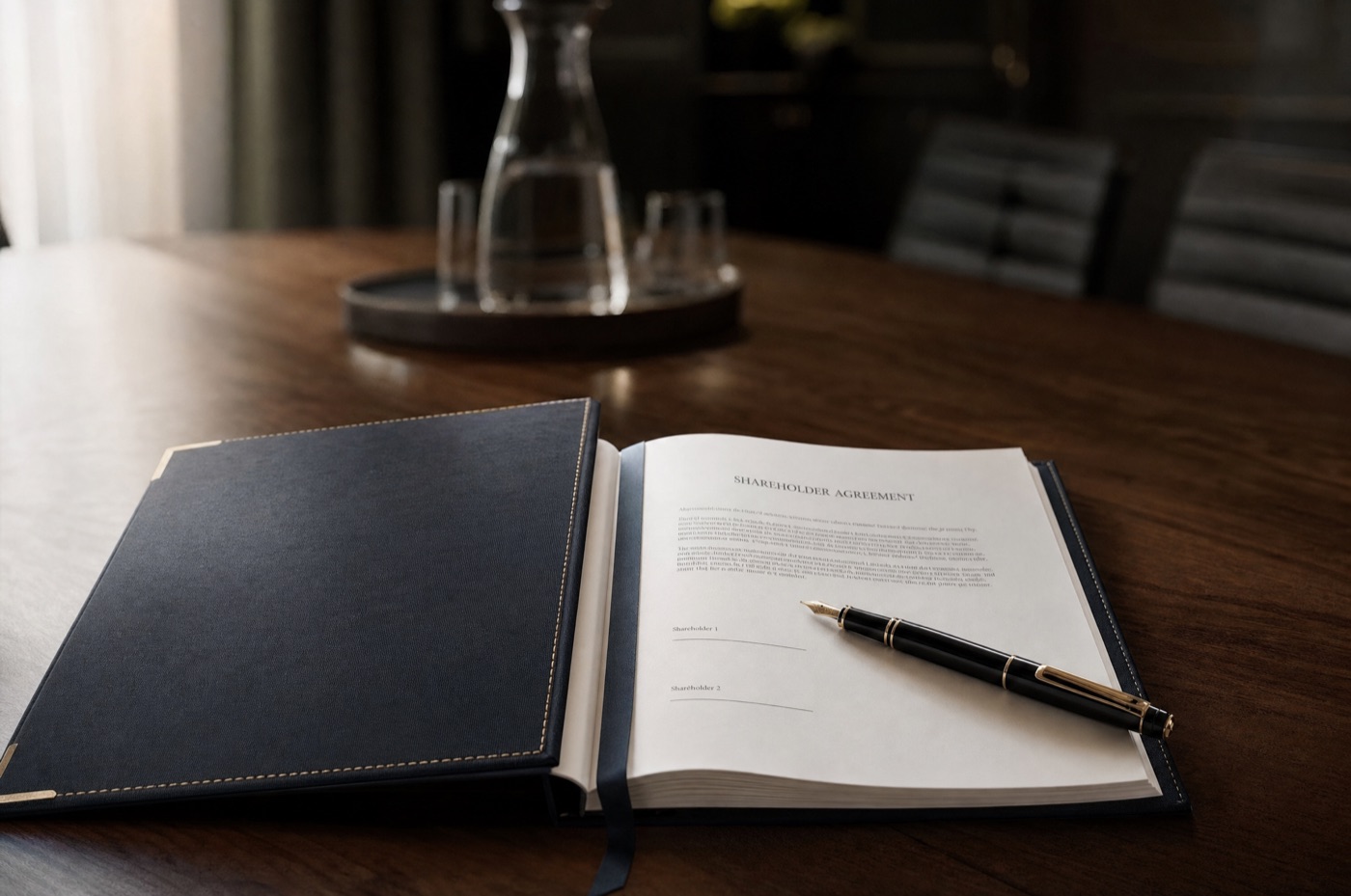
Drafted around how your company is actually set up
We draft shareholder agreements from the dispute end of the practice. Every clause we recommend exists because we have run a fight that clause would have prevented: the founder who left and competed, the 50/50 deadlock that froze the BAS, the majority that turned off dividends. Tell us your structure on a free call and a draft usually follows within two weeks.
Reviewing an agreement before you sign
If you are buying into an existing company or taking investment, someone else’s lawyer wrote the document in front of you, and it favours their client. Before you sign, we review the draft against your position: whether the leaver provisions could strip your shares at a discount, whether drag-along thresholds let others sell your stake without you, whether reserved matters actually protect a holder of your percentage, and how the valuation mechanism behaves if you are the one leaving. We read it the way we read commercial contracts, clause by clause, against what each one does to you on the day the relationship goes wrong. Reviewing it now is a great deal easier than unwinding a bad signature through the courts later. If a fight has already started, start instead at our shareholder disputes page or, where the other side is a co-director, director disputes.
Trading without a shareholder agreement?
Once a dispute starts, the owner who benefits from the gap has no reason to sign anything. One free call scopes the agreement your company actually needs.
Talk to a Melbourne shareholder agreement lawyer
Getting an agreement signed is straightforward while everyone still agrees, and close to impossible once they do not. Call 1800 130 120 or use the form on this page, and a commercial lawyer will call you back to scope what your company needs. Contract fights that have nothing to do with who owns the company go to our contract lawyers instead.
Legal Information
Talk to a lawyer before the next step

Meet the firm
Michael Kuzilny
Founder & Principal, MK Law Group
Michael has been working in the Victorian legal system since 1986. MK Law Group acts for individuals, family businesses, and commercial clients across Melbourne, with a senior lawyer on every file from the first call.
"We take on the matters we know we can run well, and we are direct about the ones we cannot."
- Practising in Victoria since 1986
- Senior lawyer on every file from day one
- Free initial advice on every new matter
Testimonials
Real reviews from real clients
Verified client reviews appear here. Want to leave one?
Share your experienceFAQs
Frequently asked questions
-
Do I need a shareholder agreement for a 50/50 company?
More than anyone. A 50/50 company with no agreement has no way to break a tie: if you and your co-owner disagree, nothing can be decided, and the only exits are a negotiated buy-out or a Supreme Court application to wind the company up or order a sale. A deadlock clause, a casting-vote mechanism or a shotgun provision costs a few paragraphs now and can save the company later. If you are already deadlocked, call 1800 130 120 and we will talk you through the options.
-
What happens if we never sign a shareholder agreement?
The Corporations Act fills the gap with its replaceable rules, and they rarely suit a small company. Directors decide whether dividends are ever paid, a simple majority can remove a director, and there is no exit mechanism at all, so a shareholder who wants out has no right to make anyone buy their shares. Your main fallback becomes an oppression claim, which is a strong remedy but a slow and expensive substitute for one signed document.
-
What clauses should a shareholder agreement include?
The ones that answer the questions that end partnerships: who can sell shares and to whom (pre-emptive rights), what happens when a majority wants to sell the company (drag-along and tag-along), how a departing founder's shares are priced (good and bad leaver plus a valuation mechanism), which decisions need everyone's sign-off (reserved matters), how profit is distributed (dividend policy), what happens in a 50/50 stand-off (deadlock clause), and whether a departing owner can set up next door (restraint of trade). We draft each one around your company rather than from a template.
-
What is the difference between a constitution and a shareholder agreement?
The constitution is the company's public rulebook, binding the company and its members, and it can be changed by a 75 per cent special resolution. A shareholder agreement is a private contract between the owners: it stays confidential, it can only be changed with the consent the agreement itself requires, and it can deal with things a constitution handles poorly, such as dividend policy, exit pricing and restraints. Most private companies need both, drafted so they do not contradict each other.
-
How much does a shareholder agreement cost?
It depends on the company. Two founders with a simple structure is a smaller job; multiple share classes, investor rights or vesting schedules add drafting time. We scope exactly what your company needs on the free first call, before anything starts. What we can say is that the owner fights we run without an agreement in place cost far more than the document ever would have.
-
Can we put a shareholder agreement in place after the company has started trading?
Yes, and if you are reading this with a company already running, do it now. An agreement can be signed at any time all shareholders agree, and the best window is while relations are still good. Once a dispute has started, the leverage has shifted and the party benefiting from the gap has no reason to sign. We can usually turn around a draft within two weeks of the first call.
- 30+
- Years in Victorian civil work
- 1,500+
- Files run end-to-end
- 4.7
- Average Google rating
- 24/7
- Free initial advice
Be in touch
Talk to a Melbourne civil lawyer today
Free first call. Honest assessment. No obligation. Reach us by phone, email, or the form below.
- marcus@mklawfirm.com.au
- 1800 130 120
- 2/212 Barkly Street, St Kilda VIC 3182